She’s alive 🧟♀️: Doing it myself, my chapbook is here
(Originally published via Substack on November 12, 2025)
Unearthed from below my bed, my 12-year-old creative writing thesis from college is reimagined, self-published as a fiction chapbook, and available for purchase.
Why now?
The impetus mirrors a theme of the book: motherhood, daughterhood, and what tangles up between them.
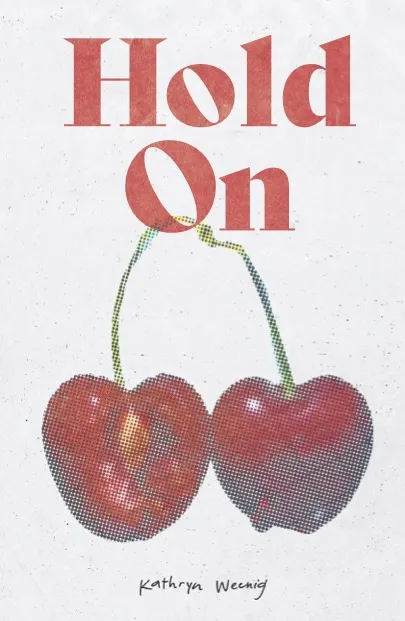 Cover by Jack Alan Design
The knot mom tied in my swimsuit presses into the back of my neck. The strings wrap around and into one another despite how hard I wrestle them with my fingers and teeth. If I had a daughter, I’d tie her suit tight. But, I’d untie it when I hung it to dry. (Hold On, pg. 9)
I’ll explain by starting several years after I originally wrote it.
I was 25, juggling a collection of jobs, and tinkering with a creative practice inspired by artists subverting the “cult of domesticity / true womanhood.” That’s to say, I was spreading beauty products on gallery walls, confident only in what I was no longer going to be when I “grew up”: Mormon.
During this time, I read the opening to Terry Tempest Williams’ book When Women Were Birds. This was years before I learned of my mom’s connection to her. The culturally Mormon, eco-feminist writer and activist taught my mom in elementary school. She challenged her academically and hosted her and a friend for lunch. I picture a relationship like Ms. Honey and Matilda’s, without the magic (unfortunately).
When Women Were Birds begins when Williams inherits full shelves of her late mother’s journals—all the pages of which were empty. At age 25, the image settled in my memory. It echoed nearly a decade later when my mom’s own mother died in 2024.
The unsaid was also a motif at my grandma’s Mormon funeral. I didn’t know her well. So, to stew in my feelings, I watched the movie Women Talking while my then 6-month-old daughter slept in my arms.
Rooney Mara’s character asks a man from her patriarchal religious community, “How would you feel, if in your entire lifetime, it had never mattered what you thought?” She captivated me. I thought of the empty journals, my matrilineage, and the timeworn thesis under my bed indicative of a lapsed creative practice.
My daughter made the odd noises of an infant. Would I hand silence down to her?
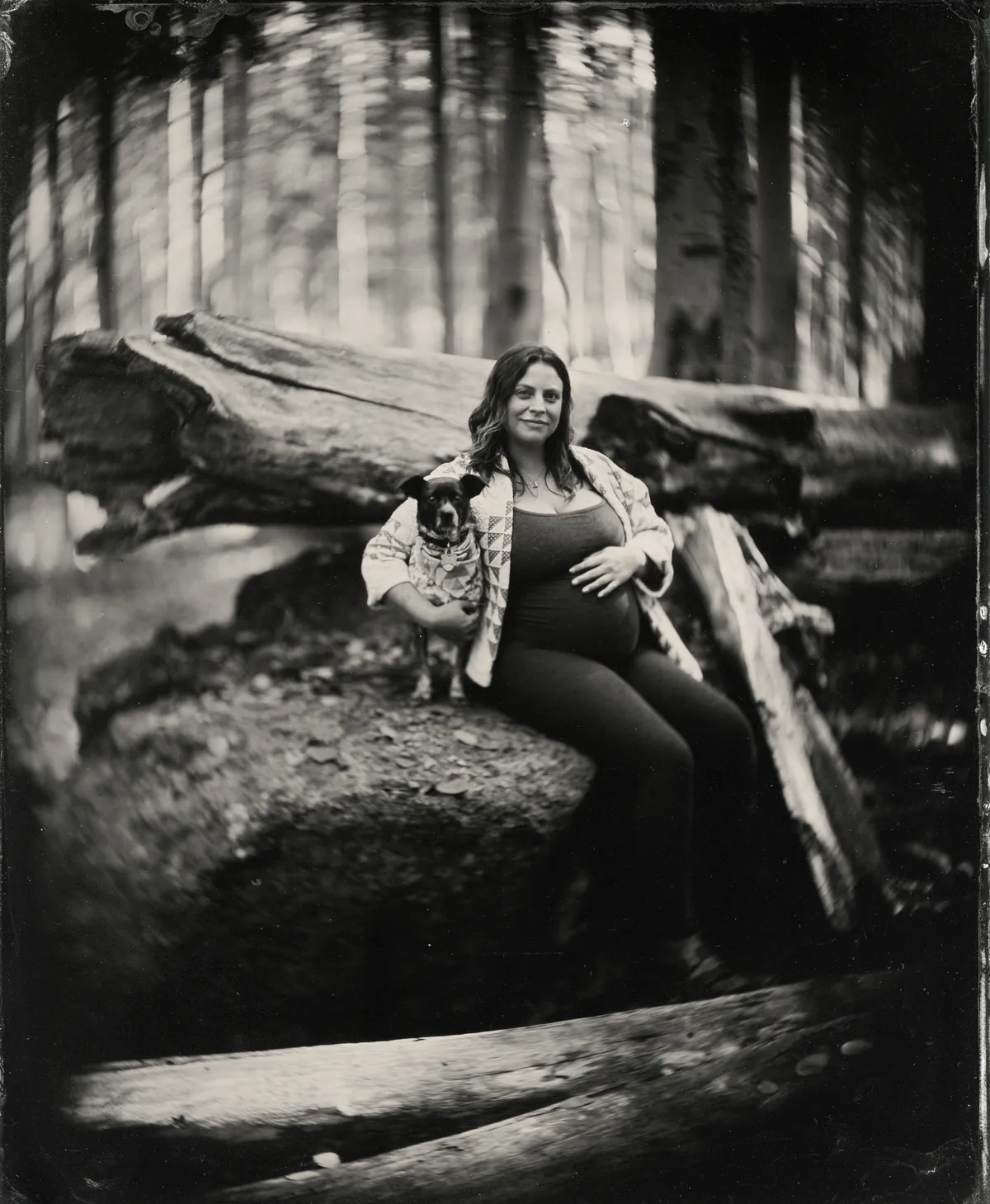 Pregnant with my daughter (alongside her fairy dog mother, Billie) | Tin type by Eric Retterbush
Contemporary politics in the U.S. compounded my fear. The “cult of domesticity / true womanhood” was mainstreamed again, and evangelizing.
During these years, I’d intermittently revised my thesis and tracked submission cycles to literary journals. I’d waited for an institutional opportunity or spontaneous cure to perfectionism to make work again.
Like a good ex-Mormon girl, perfectionism lives in my nervous system. I’ve tried to outrun it. I freeze at go. I’ve tried to starve it. Below a layer of ice, its current quickens. That’s to say, a woman’s silence gives me no doubt about the dynamism of her inner life.
Yet, I want my daughter’s tradition to be speaking aloud. So I have to do it myself.
A woman’s silence gives me no doubt about the dynamism of her inner life.
In Hold On, Alex and her mom navigate patriarchy in a different context (Florida). The chapbook is a record of Alex’s inner life. She traces the girls and women around her—mom, sister, best friend, best friend’s grandma. The most tension occurs between her and her mom. She runs toward her. She runs away from her. Regardless, her mom—flawed like everybody—waits for her.
“Mom, I’m carsick.”
“Focus on the road.” She pulls into a gas station and buys me Cherry Coke with extra crushed ice. She sits me in the front seat and rolls down the window. She lets me hang my feet outside even though the highway wind hurts her ears as we drive south toward the Fakahatchee.
We eat lunch at Fish Monger. I collect my bones at the edge of Mom’s plate. She says that fish bones should hook you as you eat them.
“It’s only fair.”
“Alexandrine hooked up with a boy last night.” C.J. grabs ketchup from the dish on my side of the table. I hit her hand. The packet lands in Mom’s coffee.
“Easy.” Mom wraps her hand around my fingers as I retrieve the floating packet. “You’ll burn yourself.” Splashes of brown cover her baby blue tank top.
“Why are you hiding it?” C.J. reaches for the condiments on the table behind us. The first time she got drunk was on Smirnoff Ice with Mom before she left for Gainesville on scholarship. When Mom got sober, they got even closer. On the weekends C.J. comes home, she still cries to Mom about her high school boyfriend.
(Hold On, pg. 7)
Read more here.